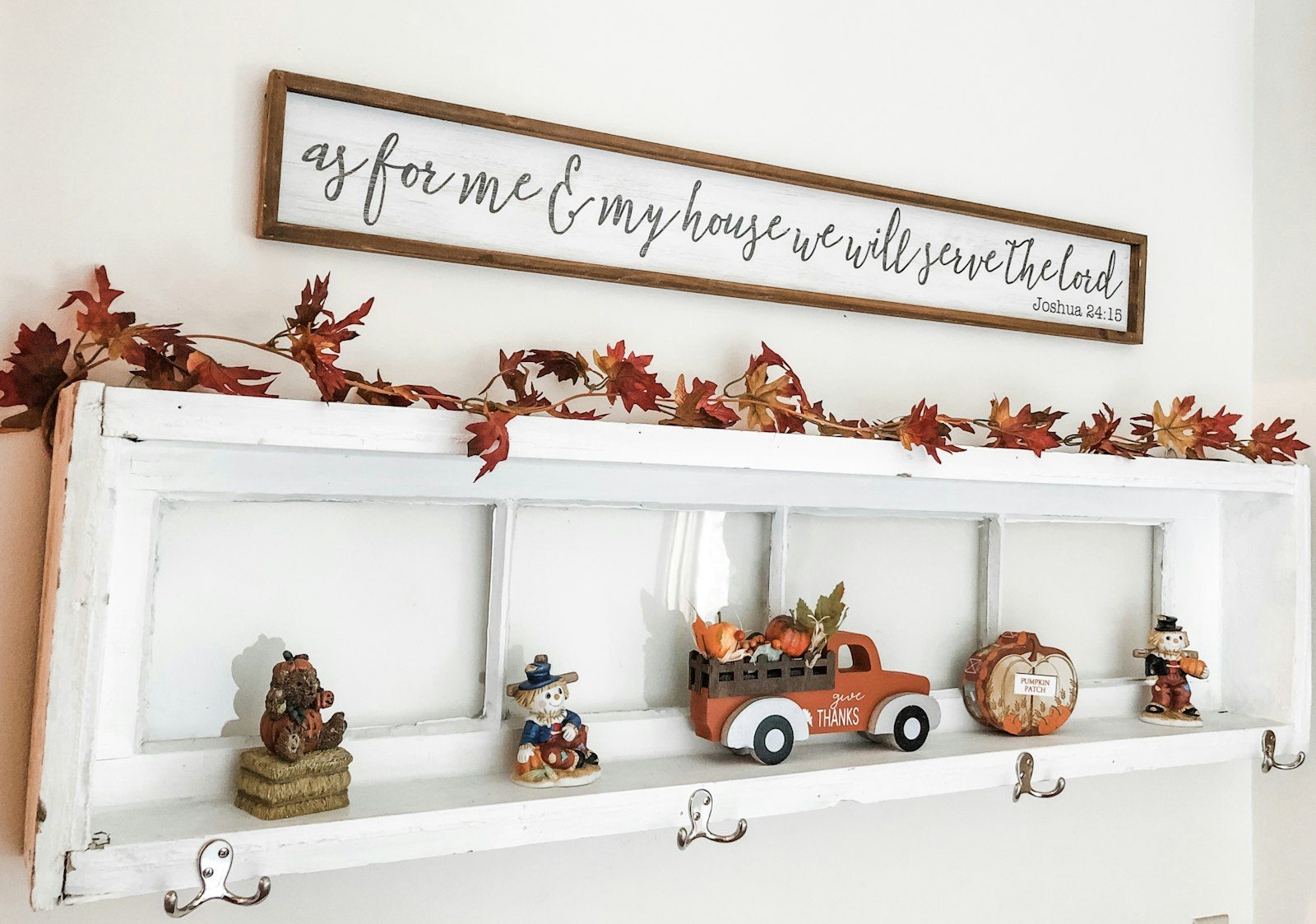
The Thanksgiving mantel has an unfair advantage: it’s the only holiday mantel that gets to be about abundance rather than sparkle. No twinkle lights required. No color scheme debates. Just wheat, pumpkins, dried leaves, and candlelight — the visual language of harvest, which humans have found beautiful for roughly ten thousand years. It’s hard to get wrong, and when you get it right, it’s the warmest surface in the house.
There’s also a strategic reason to nail your thanksgiving mantel decor: Thanksgiving is November 27 this year, and Christmas decorating starts basically the next morning. A smart Thanksgiving mantel is designed to transition — swap the pumpkins for greenery, keep the candles and the wheat, and you’re halfway to Christmas without starting over. Several of these 10 ideas are built with that handoff in mind.
The Harvest Foundation
1. The Wheat-and-Pumpkin Classic
Dried wheat bundles laid along the mantel, interspersed with mini pumpkins in white, orange, and green, plus three pillar candles at varying heights. This is the Thanksgiving mantel in its purest form — harvest symbols, warm light, nothing fussy. The wheat is the secret weapon: it keeps for years, costs almost nothing, and instantly reads “autumn.”
Space: mantel width + 12 in. wheat drape. Cost: $20–$40. Fine for renters. Storage: wheat keeps for years; compost pumpkins.
2. The Dried-Leaf Garland
String dried maple and oak leaves on twine and drape it in swags across the mantel — the same swag technique as a Christmas garland, but with leaves instead of pine. Tuck in a few dried orange slices for color. It smells like autumn, it costs nearly nothing if you gather the leaves yourself, and it photographs like a dream.
Space: mantel width × 2 for swag slack. Cost: $5–$15. Fine for renters. Storage: compost; it’s leaves.
3. The Corn-and-Gourd Still Life
Indian corn (the multicolored dried kind), an assortment of gourds, and a couple of artichokes — arranged like a Dutch still-life painting, asymmetrical and abundant. This one leans traditional in the best way. The trick is odd numbers and varying heights: three gourds, five ears of corn, never in a straight line.
Space: 48–60 in. arrangement. Cost: $15–$30. Fine for renters. Storage: gash the gourds for compost; corn keeps as decor.
Warm Candlelight Layers
4. The Amber Glass Glow
A row of amber glass votives and hurricanes — no pumpkins, no wheat, just firelight through amber glass. It’s the most modern option here and the easiest: buy a set of amber vessels, add tea lights, done. The amber tint makes everything look like golden hour, permanently.
Space: 5–7 vessels. Cost: $25–$50. Fine for renters. Storage: nest in a bin.
5. The Taper Candle Harvest Line
Taper candles in fall tones — burnt orange, deep gold, chocolate brown — in simple holders, interspersed with scattered acorns and hazelnuts. The tapers give you height without the visual weight of a big arrangement, and the nuts at the base ground the whole thing in harvest texture.
Space: 6–8 tapers. Cost: $20–$40. Fine for renters. Storage: candle box.
6. The Lantern Pair
Two lanterns flanking the center of the mantel, filled with LED candles and surrounded by mini pumpkins. Lanterns are the workhorse of transitional decor — they look right in October, November, and December. Buy them once, use them for three months straight.
Space: two 10–12 in. lanterns. Cost: $30–$60. Fine for renters. Storage: lanterns stack.
The Thanksgiving-to-Christmas Transition
This is the section that pays for itself. Design your Thanksgiving mantel so Christmas is a 20-minute swap, not a full teardown.
7. The Evergreen Base Layer
Here’s the pro move: lay a faux evergreen garland as your base now, and dress it for Thanksgiving — pumpkins nestled in, wheat tucked through, amber candles on top. After Thanksgiving, pull the pumpkins and wheat, add red berries and white lights, and you’re done. The garland never moves. Two holidays, one installation.
Space: mantel width × 2.5 (the garland rule). Cost: $35–$70 (garland is the investment). Fine for renters. Storage: garland coils into a wreath bag.
8. The Neutral Vessel Strategy
Decorate with vessels, not themes: wooden bowls, brass candlesticks, ceramic vases in warm neutrals. For Thanksgiving, fill them with pumpkins, wheat, and nuts. For Christmas, swap in ornaments, pinecones, and greenery. The vessels stay; only the fillings change. It’s the capsule-wardrobe approach to mantel decor.
Space: 5–7 vessels. Cost: $40–$80 (one-time). Fine for renters. Storage: vessels nest; fillings swap seasonally.
9. The Gratitude Banner That Becomes a Stocking Rail
Hang a “give thanks” banner now — and hang it from the same hooks or rail you’ll use for stockings in December. When Thanksgiving ends, the banner comes down and the stockings go up on the identical hardware. No new holes, no new hooks, no December ladder session.
Space: mantel width. Cost: $8–$18. Fine for renters (adhesive hooks). Storage: folds flat.
10. The Pumpkin-to-Pinecone Swap
The simplest transition of all: your Thanksgiving mantel is pumpkins + candles + wheat. On the Friday after Thanksgiving, swap every pumpkin for a pinecone and every wheat bundle for a cedar sprig. Same candles, same layout, same vessels. Ten minutes, and the mantel has crossed the seasonal border.
Space: same footprint. Cost: $10–$20 (pinecones + cedar). Fine for renters. Storage: pinecones keep forever in a tote.
What to Buy vs. What to Skip
Buy: a good faux evergreen garland (the #7 base layer — it’s the single purchase that serves two holidays), a set of amber glass votives (used year-round, not just November), and real pillar candles in fall tones. These three purchases cover your mantel from now through New Year’s.
Skip: the pre-made “fall mantel kit” from big-box stores. They’re overpriced bundles of exactly the wheat and mini pumpkins you can buy separately for half the cost, and the included banner always says something generic. Also skip anything that only works for Thanksgiving and can’t transition — single-holiday decor is how you end up with a closet of November-only junk.
Forage instead of buying: dried leaves, interesting branches, pinecones, acorns. The free stuff is often the best-looking stuff. A walk with a tote bag beats a shopping trip for mantel texture every time.
Borrow: the cake stands, the brass candlesticks, the good lanterns. Mantel decor is temporary; nobody needs to own twelve candlesticks. Friendsgiving taught us that mismatched is charming — apply the same logic here.
FAQ
When should I put up Thanksgiving mantel decor? Early November is the sweet spot — right after Halloween comes down. That gives you nearly four weeks of enjoyment before the Christmas swap. If you’re using the transition strategy (#7–#10), you’re really decorating for a two-month season, so the effort pays double.
How do I keep dried wheat and leaves from making a mess? Spray dried botanicals with a light coat of hairspray — it keeps them from shedding and adds a subtle sheen. Keep arrangements away from heating vents (forced air is the enemy of dried leaves). A quick shake outside before bringing them in removes the loose stuff upfront.
Are real candles safe on a mantel with dried leaves? This is the one place to be careful: dried botanicals are flammable. Keep open flames at least 12 inches from any dried material, use hurricanes or enclosed holders for anything near the wheat, or switch to LED candles for the mantel and save the real flames for the dining table. When in doubt, LED.
Can I use the same garland for Thanksgiving and Christmas? Absolutely — that’s the whole point of #7. A plain faux evergreen garland is seasonally neutral. Dress it with harvest elements for November, then strip and redress with Christmas elements. One garland, two holidays, zero waste. Just keep the Thanksgiving additions (pumpkins, wheat) separate so the swap is clean.
My mantel is very narrow / very wide. Do the proportions change? The formulas scale: garland length is always mantel width × 2.5, candle count is roughly one per 12 inches of mantel. On a narrow mantel (under 48 inches), go vertical — taller candles, a taller centerpiece — to compensate. On a wide mantel (over 72 inches), you need more stuff, not bigger stuff: repeat the pumpkin-candle-wheat cluster twice with a gap in the middle rather than stretching one cluster thin.
I don’t have a fireplace. Can I still do a Thanksgiving mantel? Yes — a console table, a bookshelf top, or even a wide windowsill works as a “mantel.” The principles are identical: a horizontal surface at roughly eye level, layered with harvest texture and candlelight. The transition strategy works too — your console-table display swaps to Christmas the same way. Don’t let the lack of a fireplace stop you; most of the ideas here never needed one.
The Verdict
The best thanksgiving mantel decor does two jobs: it makes November feel abundant, and it sets up December to be easy. Build on a neutral evergreen or vessel foundation, layer in the harvest stuff — wheat, pumpkins, amber light — and plan the Christmas swap before you even start. Thanksgiving is November 27; Christmas decorating starts November 28. Decorate like you know what’s coming, because you do.