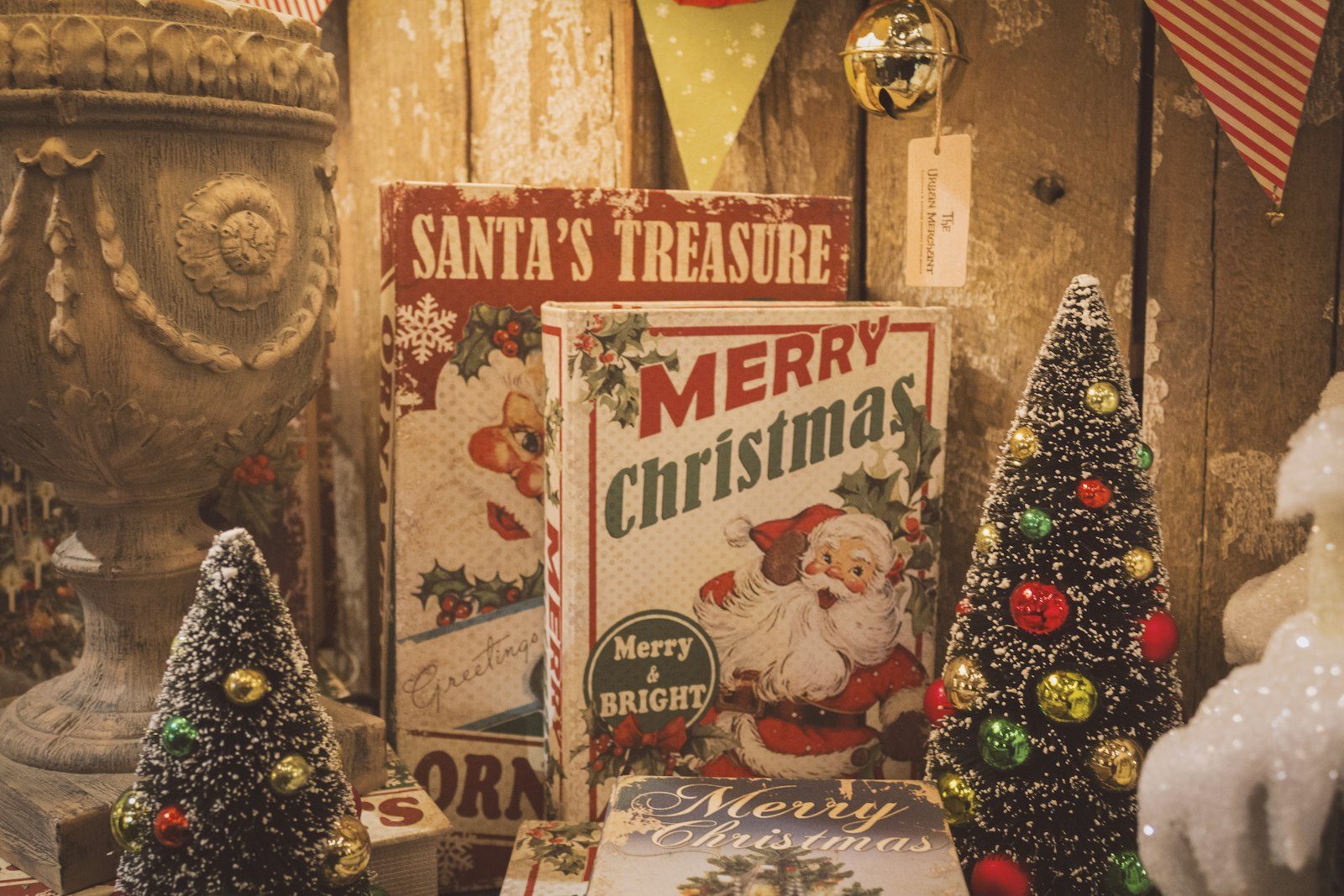
Thrift stores in October and November are Christmas goldmines, and most shoppers walk right past the good stuff. They see dusty boxes of old ornaments and think “junk.” Collectors see the same boxes and think “mercury glass, $2 each.” The difference is knowing what you’re looking at.
Vintage Christmas decor has something new decor can’t fake: patina. The slightly worn paint on a 1960s Santa, the weight of a real glass ornament, the glow of an old ceramic tree — these things read as authentic because they are. This guide covers what’s actually worth buying secondhand, how to tell real vintage from reproduction, how to clean it without ruining it, and how to mix it with modern pieces so your home looks curated, not like a museum gift shop.
What’s Actually Worth Buying Secondhand
1. Shiny Brite Ornaments
The holy grail of thrift-store Christmas. Shiny Brite glass ornaments — made in the US from the 1940s through the 1960s — are identifiable by their silvered interiors, hand-painted designs, and the distinctive cardboard caps stamped “Shiny Brite.” They’re lightweight, gorgeous, and increasingly collectible.
What to look for: intact silvering (no dark spots inside), original paint, and unbent caps. A box of 12 in good condition for under $15 is a genuine find — individual ornaments sell for $5 to $15 each online. Even partial boxes are worth grabbing; mix them with plain modern balls in matching colors.
Space: standard 2–3 in. balls. Cost: $1–$5 each thrifted. Fine for renters. Storage: wrap individually; glass is thin.
2. Bottle-Brush Trees
Those fuzzy little trees that look like pipe cleaners had a baby with a pine forest. Vintage bottle-brush trees (1940s–1970s) come in green, white, pink, and even neon colors, often with tiny ornaments or “snow” flocking. They’re the backbone of vintage Christmas styling.
The good ones are dense and full — cheap modern reproductions look sparse by comparison. Check that the bristles are firmly attached (give it a gentle shake; shedding is normal, bald spots are not). Sizes run from 3 inches to 3 feet; the 6 to 12-inch range is the most versatile for mantels and shelves.
Space: 3 in.–3 ft.; 6–12 in. most useful. Cost: $2–$12 thrifted. Fine for renters. Storage: stand upright in a box; they crush easily.
3. Ceramic Christmas Trees
The light-up ceramic tree — green or white, with multicolor plastic peg lights — is the single most nostalgic Christmas object in America. Vintage ones (1970s–1980s, often Atlantic Mold or similar) have better glaze and richer colors than modern reproductions.
Test before you buy: plug it in at the store if there’s an outlet (there usually is near the lamps). Check for the base, the star topper, and as many peg lights as possible — replacements exist online but cost more than you’d think. Hairline cracks in the ceramic are common and usually stable; chips on visible edges are not.
Space: 12–19 in. H most common. Cost: $10–$40 thrifted. Fine for renters. Storage: wrap in bubble wrap; keep pegs in a baggie.
4. Mercury Glass
True mercury glass (silvered from the inside, 19th to mid-20th century) has a mirror-like finish that modern “mercury glass look” pieces can’t quite match. You’ll find it as ornaments, candle holders, vases, and garland beads at thrift stores — often unrecognized and underpriced.
The test: hold it up to light. Real mercury glass shows a distinctive mottled silvering with slight imperfections; modern reproductions look uniformly sprayed. Don’t pay antique prices for the reproduction stuff — but do grab real pieces when they’re priced like ordinary decor, because they weren’t.
Space: ornaments to vases. Cost: $2–$15 thrifted. Fine for renters. Storage: silvering scratches; wrap individually.
5. Aluminum Christmas Trees
The silver aluminum tree — the one from “A Charlie Brown Christmas” — is the ultimate vintage statement. Original 1960s trees (Evergleam, Pom Pom, and others) in good condition with all branches and sleeves are genuinely valuable, often $100-plus.
What to check: count the branches (most came with 40–80), look for the original color wheel (the rotating light that made it famous), and inspect for bent or missing foil strips. Even incomplete trees sell — but know what you’re paying for. A tree without its color wheel is worth roughly half.
Space: 4–7 ft. assembled. Cost: $30–$150+ thrifted. Fine for renters. Storage: original box ideal; branches in sleeves.
6. Vintage Santa Figures & Mugs
Ceramic Santas, Santa mugs, and chalkware figures from the 1950s–1980s have a charm that modern versions strain to copy — the rosy cheeks, the slightly lopsided smile, the hand-painted details. They’re also among the cheapest vintage Christmas finds.
Look for maker’s marks on the bottom (Japan, Taiwan, and Hong Kong stamps date them to specific eras). Avoid anything with lead paint concerns for food use — vintage Santa mugs are for display, not cocoa, unless you’re certain of the glaze. Chalkware is fragile; check for repairs, which show as slightly-off paint patches.
Space: 4–12 in. figures. Cost: $3–$15 thrifted. Fine for renters. Storage: wrap in tissue; chalkware chips easily.
How to Tell If It’s Really Vintage
Check the marks. Flip everything over. “Made in Japan” (pre-1970s), “Made in Hong Kong” (1970s–80s), “Made in Taiwan” (1980s–90s), and specific maker names (Shiny Brite, Atlantic Mold, Holt Howard) all date a piece. No mark at all often means older — or a modern knockoff. When in doubt, a quick phone search for the mark settles it.
Feel the weight. Vintage glass ornaments are noticeably lighter and thinner than modern ones. Vintage ceramics feel denser. Reproductions of bottle-brush trees feel sparse and plasticky next to the real thing. Your hands learn the difference faster than your eyes do.
Look at the wear. Real age shows in specific ways: crazing (fine cracks) in old glaze, gentle paint wear on high points, slightly yellowed plastic. Reproductions fake this with uniform “distressing” that looks the same on every piece. Even, all-over wear patterns are a red flag — real wear is uneven.
Know the common reproductions. Shiny Brite, bottle-brush trees, and ceramic trees are all currently reproduced. The reproductions aren’t bad decor — but they shouldn’t command vintage prices. If a “vintage” ceramic tree is $60 at an antique mall, check whether the identical one is $35 new first.
Cleaning Vintage Decor Without Ruining It
Glass ornaments: lukewarm water, a drop of mild dish soap, soft cloth. Never soak — water seeps under loose caps and ruins silvering from the inside. Dry immediately and completely. Never use anything abrasive; vintage paint and silvering are tissue-thin.
Bottle-brush trees: don’t wash them. Seriously. A soft dry brush or a cool hair dryer removes dust. Water mats the bristles permanently and dissolves old glue. If one smells musty from storage, air it outside for a day — sunlight and fresh air fix most thrift-store funk.
Ceramic trees and figures: damp cloth, mild soap, dry thoroughly. Check electrical components before plugging in anything vintage — frayed cords and ancient bulbs are fire hazards. Replace the cord or rewire if anything looks questionable; a $15 rewiring beats a house fire.
What not to do: no bleach, no harsh chemicals, no dishwashers, no ultrasonic cleaners on anything old. When in doubt, dust it and display it. Patina is the point — over-cleaning vintage decor is how you turn a $40 find into a $5 craft project.
Mixing Vintage with Modern (Without Looking Like a Museum)
The goal is “collected over time,” not “time capsule.” The rule: let vintage be the accent, not the entire room. A mantel of all-vintage everything reads as a display; vintage pieces scattered among modern decor read as personal style.
The 70/30 rule. Aim for roughly 70% modern or neutral foundation, 30% vintage accents. Your modern tree with a cluster of Shiny Brite ornaments. Your contemporary mantel garland with vintage bottle-brush trees tucked in. The vintage pieces pop because they’re surrounded by calm.
Repeat the vintage note. One vintage Santa on a shelf looks random. Three vintage Santas grouped together look intentional. Cluster your thrifted finds — a shelf of bottle-brush trees, a bowl of vintage ornaments — rather than scattering singles around the house.
Match the palette, not the era. A pink 1960s bottle-brush tree works in a modern blush-and-gold Christmas scheme because the color connects, even though the eras don’t. Color is the bridge between vintage and modern — get the palette right and the decades take care of themselves.
FAQ
When is the best time to thrift for vintage Christmas decor?
October through mid-November, when donations from estate cleanouts hit the shelves and before the holiday rush picks them over. After Christmas is the second-best window — January donations are plentiful, though you’ll store your finds for 11 months. Avoid mid-December; the shelves are bare.
How much should I pay for vintage Christmas ornaments?
Thrift-store prices: $1–$5 per glass ornament, $2–$12 for bottle-brush trees, $10–$40 for ceramic trees. If a piece is priced higher, check online sold listings before buying — knowledge is the difference between a find and an overpay. The best deals are always in the unsorted bins, not the display case.
Is it safe to use vintage Christmas lights and electrical decor?
Inspect everything. Frayed cords, cracked plugs, and brittle wiring mean rewire or display unplugged. Vintage ceramic trees can usually be rewired cheaply with modern LED-compatible kits. When in doubt, use them as unlit decor — a ceramic tree looks great without its lights on, and nobody will know.
What’s the single best vintage Christmas find for a beginner?
Bottle-brush trees. They’re cheap ($2–$12), nearly indestructible compared to glass, instantly charming in groups, and impossible to buy wrong — every color and size works somewhere. Start with five or six in one color family and cluster them on your mantel. You’ll be hooked.
The Verdict
Vintage Christmas decor is the highest-value decorating there is: real patina, real history, thrift-store prices. Learn the marks, feel the weight, and hit the thrift stores in October before the rush. Start with bottle-brush trees and Shiny Brites, cluster your finds instead of scattering them, and let the 70/30 rule keep it curated. The best Christmas decor isn’t always new — sometimes it’s been waiting in a donation bin for you.