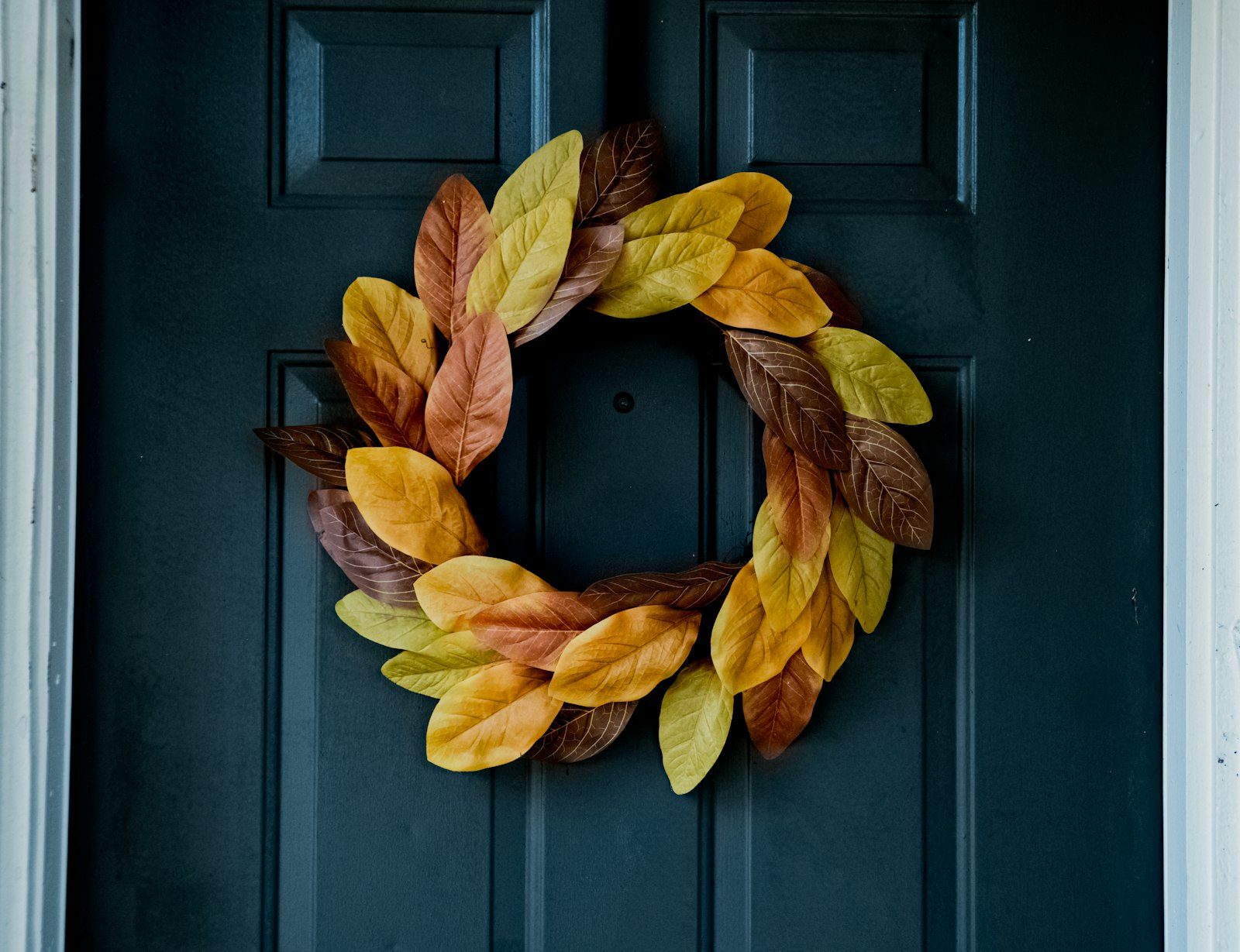
The front door is the first thing Thanksgiving guests see and the last thing they remember. And yet most fall wreaths out there commit one of two crimes: they’re comically small on a big door, looking like a postage stamp, or they’re a plastic-looking explosion of orange that screams “craft store clearance.”
A great fall wreath is simpler than you think. It needs exactly three things: the right size for your door, materials that look like they came from a garden instead of a factory, and — here’s the part nobody talks about — a plan for December. Because Thanksgiving is November 27th this year, and Christmas is four weeks later. Buy smart, and your fall wreath becomes your Christmas wreath with one addition.
This fall wreath guide covers sizing math, style choices, damage-free hanging, and the transitional wreath trick that gets you two holidays for the price of one.
The Door-Width Formula
1. Measure First, Shop Second
Here’s the formula that fixes 90% of sad front doors: your wreath’s diameter should be roughly two-thirds the width of your door. A standard 36-inch door wants a 24-inch wreath. A narrow 30-inch apartment door wants 20 inches. A grand 42-inch double door can carry 28 inches.
Too small is the most common mistake — a 16-inch wreath on a 36-inch door looks lost, like the door swallowed it. Too big looks costume-y. The two-thirds rule hits the sweet spot where the wreath reads as intentional from the street and welcoming from the porch.
Measure your door width before you leave the house. Write it in your phone. Every wreath decision flows from this number.
Space: 24 in. for a 36 in. door. Cost: $30–$80. Fine for renters. Storage: wreath box; stores flat in a closet.
2. The Double-Door Exception
Double doors break the formula — two doors, one wreath looks lopsided. The fix: hang a smaller wreath (16–18 inches) on EACH door, mirrored. Same wreath, same height, same ribbon. Symmetry does the heavy lifting.
Alternatively, hang one full-size wreath on the active door (the one that opens) and leave the other bare. This looks deliberate, not lazy — the eye reads it as “the entrance is here.” Never hang one wreath centered across both doors; it bisects the wreath every time someone comes in.
Space: 2 × 16–18 in. wreaths. Cost: $40–$90 for the pair. Fine for renters. Storage: two wreath boxes, stackable.
3. Apartment Doors and Storm Doors
Small doors (28–32 inches, common in apartments and condos) want an 18–20 inch wreath — don’t squeeze a full-size one on. And if you have a glass storm door, hang the wreath BETWEEN the storm door and the main door, where it’s protected from wind and rain. It’ll last twice as long.
Check the clearance: storm doors sit 2–4 inches in front of the main door. A deep, lush wreath (6+ inches thick) can get crushed when the storm door closes. Measure the gap before you buy the fluffy one.
Space: 18–20 in. diameter. Cost: $25–$60. Fine for renters. Storage: flat wreath bag under the bed.
Dried vs. Faux: Pick Your Fighter
4. The Case for Dried and Natural
Dried wheat, preserved eucalyptus, dried hydrangeas, lotus pods — natural materials look expensive because they ARE the real thing. Light hits them differently. They photograph like a magazine. And they smell like nothing, which matters if anyone in the house has fragrance sensitivities.
The honest tradeoff: dried wreaths are one-season items. They shed, they fade, and by January they’re compost. Budget accordingly — this is a $30–$50 annual tradition, not an heirloom. Some people love the ritual of picking a new one each fall. If that sounds like a chore, keep reading.
Space: 22–24 in. typical. Cost: $30–$55. Fine for renters. Storage: compost in January; nothing to store.
5. The Case for High-Quality Faux
Faux has one unbeatable argument: buy it once, hang it for a decade. The trick is knowing what separates good faux from sad plastic. Squeeze the leaves — good faux has varied texture and multiple shades per leaf. Hold it at arm’s length — if it looks real from six feet, it IS real enough for a front door. And check the back — a finished back means quality construction.
Spend the money here. A $70 faux wreath that looks real for ten years costs $7 per year. A $25 plastic one that looks fake costs you dignity every single day. This is one of the few decor categories where spending more is genuinely the frugal move.
Space: 24 in. standard. Cost: $60–$90 for quality faux. Fine for renters. Storage: wreath storage box; attic or closet.
6. The Hybrid Move
Can’t decide? Go hybrid: a quality faux base wreath, then tuck in fresh or dried accents each season. Eucalyptus sprigs from the grocery store ($4) pushed into a faux base transform it from “fine” to “where did you GET that.” Swap the accents in December for pine and berries, and nobody will ever know it’s the same wreath.
This is the stylist’s secret. The base is the investment; the accents are the outfit change. Three seasons, one wreath, endless compliments.
Space: base 24 in. + accents. Cost: $60–$90 base + $5–$10 accents. Fine for renters. Storage: base in a box; accents compost.
Hanging Without Damage
7. The Over-the-Door Hanger
The classic metal over-the-door wreath hanger works — with one caveat. On a 1¾-inch exterior door, the hanger can scratch the top of the door and let in drafts. Fix both problems with felt pads on the metal contact points and a hanger sized for your door thickness, not a generic one.
For glass storm doors, skip the over-door hanger entirely (it won’t fit) and use a suction-cup hook rated for the wreath’s weight. Test it for 24 hours before trusting it with your good wreath.
Space: fits 1⅜–1¾ in. doors. Cost: $8–$15. Fine for renters. Storage: drawer; use yearly.
8. The Command Hook Method
A large outdoor-rated adhesive hook on the door itself is the cleanest look — no metal visible, no draft gap, no scratching. The outdoor-rated strips handle temperature swings that defeat indoor versions. Clean the door surface with rubbing alcohol first; this doubles the hold.
One honest warning: in extreme cold (below 20°F), even outdoor adhesive can fail. If you live where November means real winter, check the hook weekly or default to the over-door hanger. A wreath on the porch floor is a sad sight.
Space: holds up to 7 lbs. Cost: $6–$10 for a 2-pack. Fine for renters. Storage: nothing — strips are single-use.
The Transitional Wreath: Two Holidays, One Purchase
9. Buy for Thanksgiving, Convert for Christmas
Here’s the move that pays for the wreath twice: choose a fall wreath with a neutral base — grapevine, mixed greens, wheat — in warm neutrals rather than screaming orange. It looks like autumn now. Then, the weekend after Thanksgiving, tuck in pine sprigs, red berries, and a plaid or velvet ribbon.
Same wreath. Completely different holiday. The base was the investment; the December accents cost about $12 at any craft store. Your neighbors will think you bought a new wreath. Let them.
This works best with the hybrid approach from section 6, but it works with a full natural wreath too — just plan for the base to retire in January after two months of honorable service.
Space: same 24 in. base. Cost: +$10–$15 for Christmas accents. Fine for renters. Storage: one wreath box covers both holidays.
FAQ
When should I hang my fall wreath? Early to mid-October is the sweet spot — it covers the whole fall season through Thanksgiving. Hanging it the week of Thanksgiving is fine too; a wreath takes five minutes and instantly signals “we’re ready.” Take it down (or convert it) the weekend after Thanksgiving if you’re going the transitional route.
How do I keep a dried wreath from shedding all over my porch? You don’t, entirely — shedding is the nature of dried materials. Minimize it with a light mist of hairspray on the wreath before hanging (the cheap aerosol kind works best), which binds loose bits. Place a small doormat underneath to catch what falls. And hang it in a sheltered spot — wind is the real enemy, not gravity.
Can I use the same wreath hanger for Christmas? Yes, if it’s rated for the weight. Christmas wreaths with ornaments and lights run heavier than fall wreaths — check your hanger’s weight rating before December. When in doubt, upgrade the hanger; a $12 hanger is cheaper than a shattered ornament collection.
What’s the best fall wreath color if my door is already a bold color? Go neutral. A red door with an orange wreath is a color collision. Wheat, dried greens, cream hydrangeas, and natural grapevine complement any door color — including black, navy, and red. Let the door be the star; the wreath is the supporting actor.
The Verdict
A fall wreath is the highest-visibility, lowest-effort decor move of the Thanksgiving season. Measure your door, pick the two-thirds size, choose materials you’d actually want to look at for two months, and hang it without damaging the door.
And if you buy the transitional base — neutral, quality, convertible — you’ll still be enjoying it in December with a handful of pine sprigs. Two holidays, one wreath, zero regrets. That’s the kind of math this whole site is built on.